
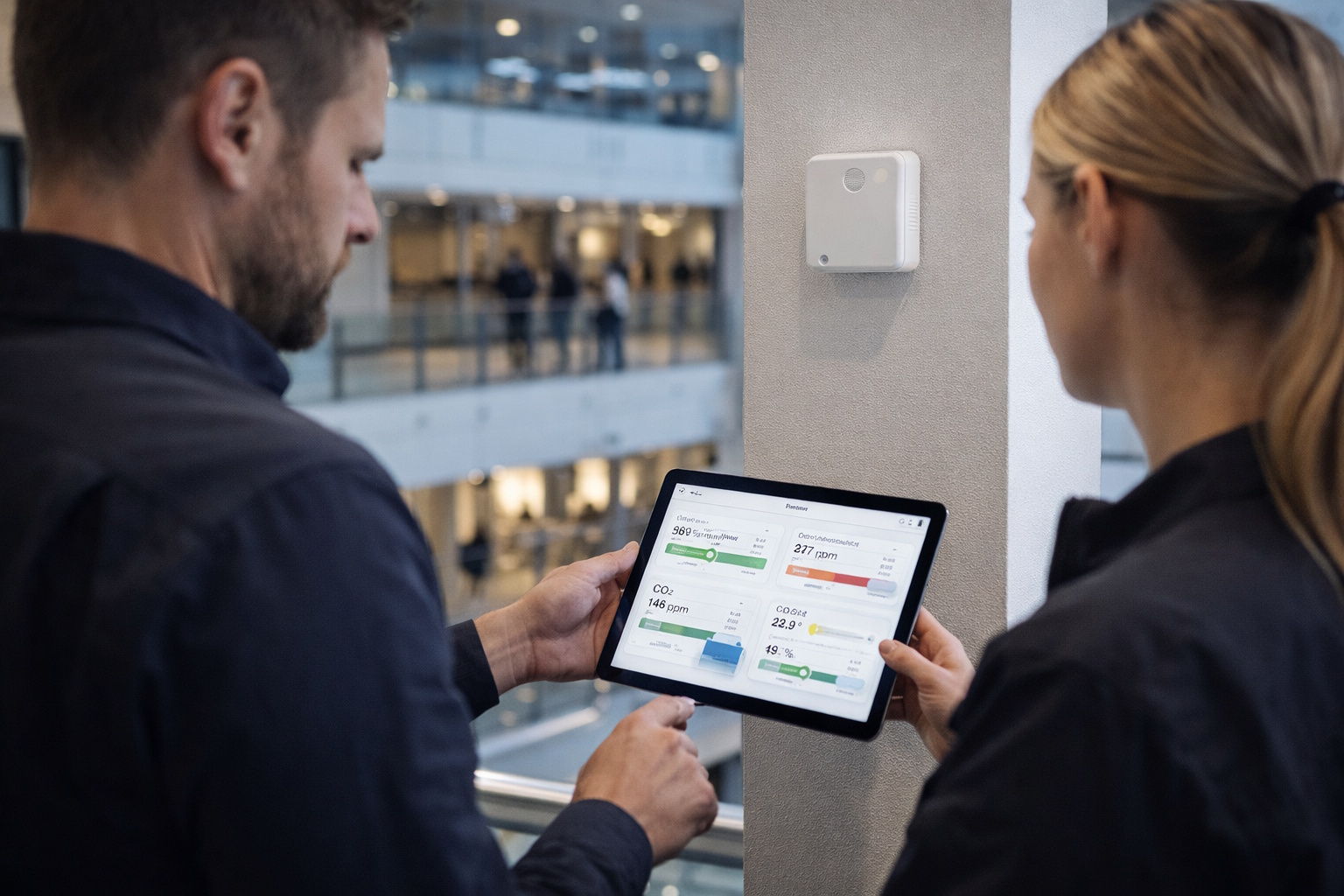
Luftkvalitet
Sikre et sunt inneklima med kontinuerlig overvåking av luftkvalitet. Mål CO2, flyktige organiske forbindelser, partikler og fuktighet for bedre helse og produktivitet.
Godt inneklima gir bedre resultater
Dårlig luftkvalitet påvirker konsentrasjon, helse og trivsel. Med kontinuerlig overvåking kan du sikre at inneklimaet holder høy standard og reagere raskt på forverring.
CO2-måling
Overvåk karbondioksidnivåer som indikator på ventilasjon og luftutskifting.
VOC-deteksjon
Mål flyktige organiske forbindelser fra maling, møbler og rengjøringsmidler.
Fuktighet
Hold fuktigheten på et komfortabelt og sunt nivå for å unngå mugg og tørr luft.
Partikkelmåling
Overvåk finpartikler (PM2.5/PM10) for å sikre ren luft.
Sanntidsvisning
Se luftkvaliteten i sanntid på skjermer i lokalet eller i portalen.
Ventilasjonsoptimalisering
Bruk data til å styre ventilasjonen behovsstyrt og spare energi.
Slik måler vi luftkvalitet
Fra installasjon til bedre inneklima.
Plassering
Vi identifiserer kritiske soner og plasserer sensorer for representativ måling.
Installasjon
Diskret montering av sensorer som kontinuerlig måler luftkvaliteten.
Grenseverdier
Vi setter opp varsler basert på anbefalte grenseverdier og dine preferanser.
Handling
Ved avvik får du varsler og kan iverksette tiltak som økt ventilasjon.
Hvem trenger luftkvalitetsmåling?
Godt inneklima er viktig i mange ulike miljøer.
Kontorer
Bedre konsentrasjon og mindre sykefravær med optimal luftkvalitet.
Skoler og barnehager
Sikre god luftkvalitet for barn og ansatte gjennom hele dagen.
Helseinstitusjoner
Kritisk luftkvalitet for pasienter og ansatte i sykehus og klinikker.
Treningssentre
Høy aktivitet krever god ventilasjon og ren luft.
Butikker og kjøpesentre
Behagelig inneklima for kunder og ansatte øker trivsel og salg.
Hoteller
Sikre gjestene et godt inneklima på rom og i fellesarealer.
Fordeler med luftkvalitetsmåling
Godt inneklima gir målbare fordeler.
- Bedre helse og færre plager
- Økt produktivitet og konsentrasjon
- Behovsstyrt ventilasjon sparer energi
- Dokumenter overholdelse av arbeidsmiljøkrav
- Økt trivsel for ansatte og besøkende
- Historikk for analyse og forbedring
Integrert med Insight Portal
Alle våre sensorer og tjenester kobles til vår egenutviklede portal for enkel tilgang til data og analyse.
Vanlige spørsmål
Finn svar på de vanligste spørsmålene om denne tjenesten.
Under 800 ppm regnes som bra, 800-1000 ppm er akseptabelt, over 1000 ppm indikerer behov for bedre ventilasjon.
Det avhenger av lokalets størrelse og layout. Typisk plasseres én sensor per sone eller rom.
Ja, vi kan integrere med SD-anlegg for behovsstyrt ventilasjon basert på faktiske målinger.
Ja, de fleste av våre luftkvalitetssensorer inkluderer også temperatur- og fuktighetsmåling.
Du kan motta varsler via SMS, e-post eller push-notifikasjoner når verdier overskrider grenser.
Vil du forbedre inneklimaet?
Ta kontakt for å diskutere hvordan luftkvalitetsmåling kan hjelpe din virksomhet.