
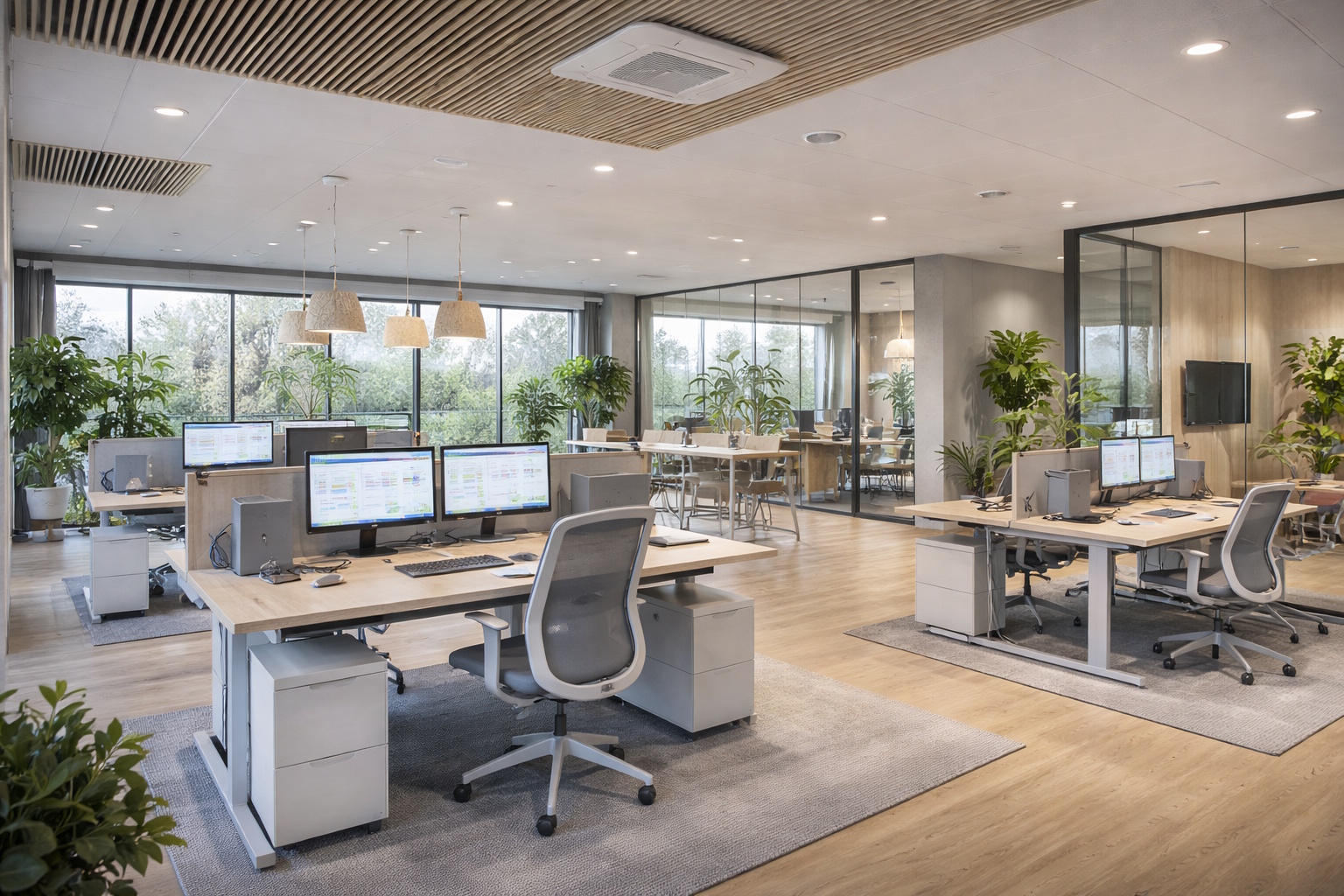
Smarter office buildings with IoT and sensor data
Modern office buildings are about more than four walls and a roof. With IoT sensors, you gain insight into how the building is actually used – from meeting room utilization and indoor climate to energy consumption and maintenance needs. The result is a better work environment, lower operating costs and more satisfied tenants.
Office buildings are often managed blindly
Most office buildings are operated based on assumptions and fixed routines. Ventilation runs at maximum all day – regardless of whether there are 10 or 200 people in the building. Meeting rooms are booked but empty. Cleaning happens on schedule, not on demand. And when tenants complain about indoor climate, facility managers lack the data to assess the situation objectively.
With IoT sensors, you get objective, real-time data about how the office building is actually used and performing. This provides the foundation for smarter decisions that directly impact the bottom line and work environment.
30-50%
Of meeting rooms not used as booked
15-30%
Potential for energy savings
800 ppm
CO2 limit for good concentration
24/7
Continuous monitoring
IoT solutions for office buildings
Each sensor provides insights that can be translated into a better work environment, lower operating costs and more efficient use of space.
Space utilization and occupancy
Know exactly which meeting rooms, zones and floors are actually in use – and when. Uncover meeting rooms that are booked but empty, identify popular zones and optimize space planning based on actual usage instead of assumptions.
- Uncover actual usage of meeting rooms and common areas
- Optimize space planning for renovations or downsizing
- Document occupancy for tenant negotiations and space efficiency
Air quality and CO2
High CO2 levels noticeably reduce concentration and productivity. By monitoring CO2, humidity and particle levels in real time, you can control ventilation based on actual demand. The result is better indoor climate for employees and lower energy costs for the building owner.
- Demand-driven ventilation saves 15-25% energy
- Better concentration and well-being for employees
- Document indoor climate quality (regulatory compliance)
Temperature monitoring
Monitor actual temperature in all zones – open-plan offices, private offices, meeting rooms, server rooms and common areas. Detect cold spots, hot spots and deviations between set and actual temperature. Document indoor climate objectively when tenants complain.
- Detect deviations between thermostat and actual temperature
- Prevent frost damage in technical and server rooms
- Document temperature history for complaints
Energy measurement and consumption analysis
Understand where energy in the office building goes. Monitor consumption for lighting, ventilation, heating and cooling per floor and zone. Identify equipment using power outside working hours, and set up alerts for unexpected consumption increases.
- Identify energy waste outside working hours
- Distribute energy costs fairly between tenants
- Document sustainability measures for ESG reporting
Leak detection
Water damage in office buildings can be extremely costly – especially in technical rooms, server rooms and basements. Wireless sensors alert immediately at the first sign of moisture, often days before the damage becomes visible.
- Protect server rooms and technical infrastructure
- Monitor basements, restrooms and technical shafts
- Reduce insurance premiums with documented prevention
Central dashboard
Consolidate all sensor data in one clear platform. View real-time status for the entire building, drill down into individual rooms and zones, and generate automatic reports for owners, tenants and operations staff.
- All sensors and data in one view
- Automatic reports and alerts
- API, FTP, MQTT and MCP integrations for AI and third parties
How office buildings use IoT data
Concrete examples of how IoT sensors improve operations and work environment in office buildings.
Meeting room optimization – end ghost meetings
An office building with 40 meeting rooms installed occupancy sensors and discovered that 35% of booked rooms were never used. By introducing automatic release of unused rooms after 10 minutes, actual utilization increased by 25% – without adding a single new room.
Demand-driven ventilation – fresh air when needed
CO2 sensors in an office building revealed that ventilation ran at full capacity even on weekends and after working hours. By linking ventilation to actual occupancy and CO2 levels, the building owner reduced energy costs by 20% – and employees reported better indoor climate during working hours.
Temperature complaint resolved with data
A tenant repeatedly complained that it was too cold on the 3rd floor. Temperature logs from IoT sensors showed that the temperature consistently stayed at 21.5°C. The problem turned out to be a draft from a window – not the HVAC system. The data saved the facility manager from a costly HVAC review.
Server room leak detected in time
A leak sensor in the server room alerted about moisture on a Sunday morning. The IT manager received an SMS and took action within an hour. Without the sensor, the water would have reached the server racks – with potentially millions in damage to IT infrastructure and data loss.
Better work environment with data
Good indoor climate is not just a legal requirement – it directly affects productivity, sick leave and well-being. With IoT sensors, you can document and continuously improve the work environment.
Document indoor climate for HSE
Meet regulatory requirements with continuous logging of temperature, CO2, humidity and particles.
Optimize space utilization
Use actual data to plan renovations, downsizing or expansion of office spaces.
Reduce energy costs
Demand-driven ventilation and lighting based on actual occupancy can save 15-30% on the energy bill.
Integrate with existing systems
Connect to BMS, building automation or CAFM systems via REST API, MQTT, FTP or MCP.
Typical sensor placement in office buildings
Entrances & reception
People counters for occupancy tracking
Meeting rooms
Occupancy sensors for utilization and auto-release
Open-plan offices & zones
CO2, temperature & humidity sensors
Electrical rooms & HVAC
Energy meters & consumption analysis
Server rooms & basements
Leak sensors & temperature monitoring
Restrooms & common areas
Traffic counting for demand-based cleaning
Ready for a smarter office building?
Whether you are a facility manager, property manager or employer – we tailor the solution to your needs. Start with one sensor type and expand as you see the value.