
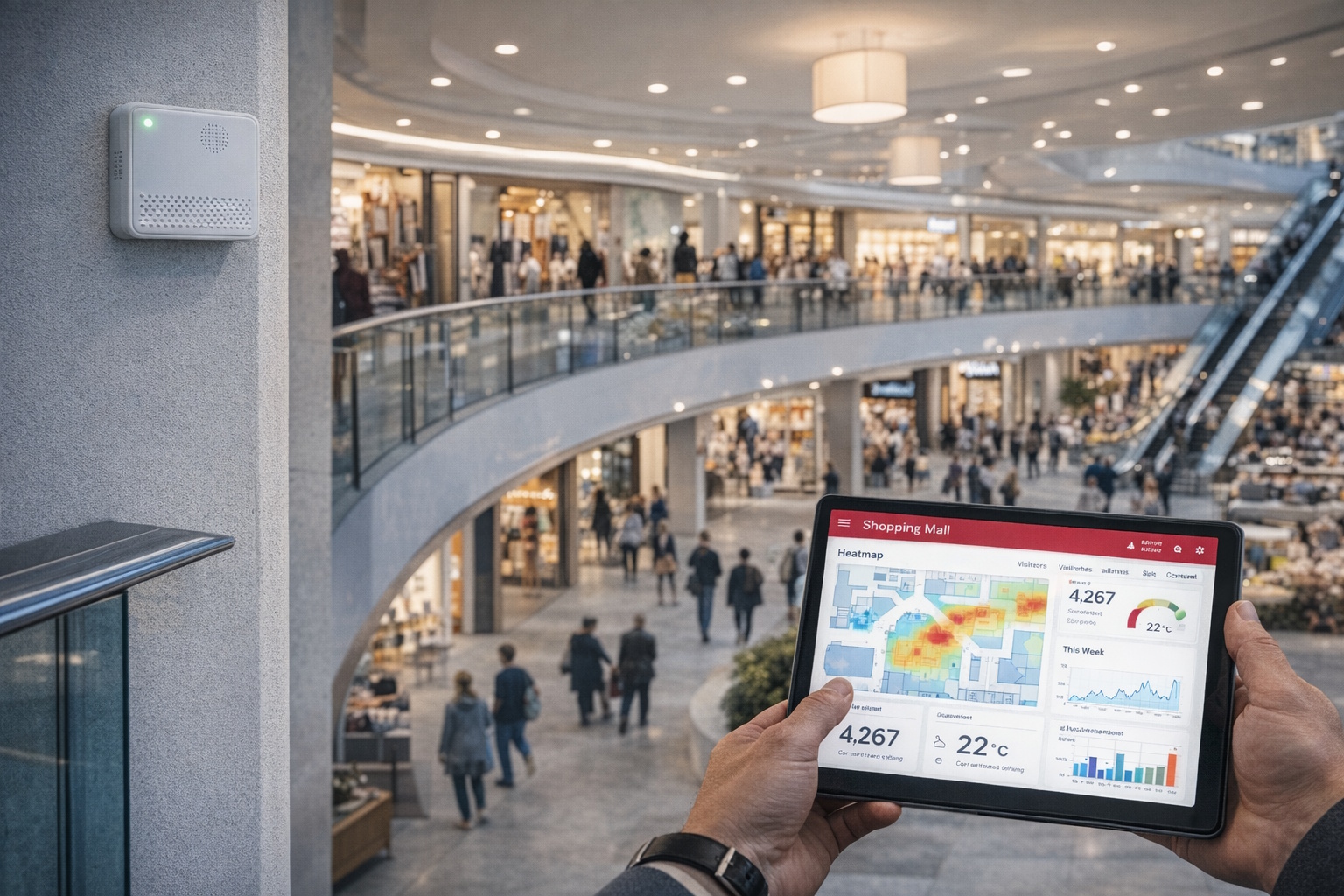
Data-driven center management with IoT and real-time data
Understand how your shopping center is actually used. From visitor counting per entrance and floor to indoor climate, energy consumption and leak detection – IoT sensors give center management the insights needed to optimize operations, document tenant value and reduce costs.
Shopping centers are often run on assumptions
How many visitors did the center have today? Which entrances are used the most? Is it too warm on the 2nd floor, or is the tenant just complaining? Is the ventilation running at max even when the center is half empty? Most shopping centers lack objective data to answer these questions.
With IoT sensors, you get real-time data on visitor patterns, indoor climate, energy consumption and building condition. The data provides the foundation for better decisions – from cleaning schedules and tenant negotiations to energy optimization and damage prevention.
100%
Visitor flow visibility
15-30%
Potential energy savings
20-40%
Smarter cleaning schedules
24/7
Continuous monitoring
IoT solutions for center management
Each sensor provides insights that translate into better operations, lower costs and stronger tenant relationships.
Visitor counting and traffic analysis
Measure visitors per entrance, floor and zone in real time. See when peaks occur, which days are busiest and how campaigns affect traffic. Use the data to document visitor numbers for tenants, optimize opening hours and plan staffing in common areas.
- Document visitor numbers for tenant negotiations
- Measure the effect of campaigns and events
- Optimize cleaning based on actual traffic
Heat maps and movement analysis
Understand how visitors move through the center. Which zones have the highest traffic? Where do people stop? Which corridors are thoroughfares? Heat maps provide visual insights that help optimize tenant placement, signage and common areas.
- Identify high and low traffic zones
- Optimize tenant placement and rental pricing
- Improve signage and customer flow
Temperature monitoring
Monitor temperature across all zones – shopping streets, common areas, food court, parking garage and technical rooms. Detect discrepancies between set and actual temperature, and document indoor climate for tenants who experience it as too warm or cold.
- Document actual temperature for complaints
- Prevent frost damage in technical rooms and parking
- Ensure comfortable shopping experience
Air quality and CO2
Shopping centers with many visitors quickly develop high CO2 levels. Poor air makes people tired and reduces dwell time. By monitoring CO2, humidity and particles, ventilation can be controlled based on actual demand – better air for customers, lower energy costs for the center.
- Demand-driven ventilation saves 15-25% energy
- Better air increases customer dwell time
- Document indoor climate for regulatory compliance
Energy metering and consumption analysis
Shopping centers are energy-intensive buildings. Monitor consumption for lighting, ventilation, escalators, elevators and cooling in real time. Identify equipment using power unnecessarily, distribute energy costs fairly among tenants and document sustainability measures.
- Identify energy waste in real time
- Distribute common costs based on actual consumption
- Document ESG and sustainability goals
Leak detection
Water damage in a shopping center can affect multiple tenants and common areas simultaneously. Wireless sensors in technical rooms, under the food court, near pipes and in the parking basement alert immediately at the first sign of moisture – before the damage spreads.
- Prevent costly water damage across floors
- Monitor technical rooms and parking basement 24/7
- Reduce insurance premiums with documented prevention
Central dashboard for center management
Consolidate all data in one platform. View visitor numbers, indoor climate, energy consumption and sensor status in real time. Generate reports for owners, tenants and operations teams – and make decisions based on facts instead of assumptions.
- All sensors and buildings in one view
- Automated reports for owners and tenants
- API, FTP, MQTT and MCP integrations
How shopping centers use IoT data
Concrete examples of how IoT sensor data enables better center operations and lower costs.
Tenant negotiations with documented visitor numbers
A shopping center installed visitor counters at all entrances and in corridors between zones. Data showed that zone A had 3x more traffic than zone C. At the next lease negotiation, center management could document the traffic differences and differentiate rental prices fairly – strengthening tenant trust and increasing total revenue.
Demand-driven cleaning saved 30% of the budget
By placing visitor counters in restrooms and common areas, the center mapped actual usage hour by hour. The cleaning schedule was changed from fixed intervals to demand-driven – more frequent cleaning during high-traffic hours, less during quiet periods. Result: 30% lower cleaning budget without reducing quality.
Ventilation linked to actual occupancy
CO2 sensors in shopping streets and the food court revealed that ventilation ran at full capacity even during quiet periods. By linking ventilation to CO2 levels and visitor counting, the center reduced ventilation energy costs by 22% – while air quality actually improved during busy periods.
Leak in parking basement detected in time
A leak sensor in the parking basement detected moisture on a Sunday evening. The operations team received an SMS and shut off the water supply within 45 minutes. Without the sensor, the water would have stood until Monday morning – with potentially hundreds of thousands in damage to technical infrastructure and vehicles.
Value for the entire value chain
IoT data creates value for all parties in a shopping center – from the center owner and manager to the individual tenant.
Center owner
Document building condition, energy efficiency and visitor trends. Strengthen ESG reporting and property value with actual data.
Center management
Optimize operations, cleaning and staffing. Use visitor data for campaign planning and tenant follow-up.
Tenants
Gain insight into visitor numbers outside your own store. Understand traffic flows and use the data to optimize staffing and opening hours.
Operations team
Receive automatic alerts for temperature deviations, leaks and energy spikes. Prioritize tasks based on data instead of complaints.
Typical sensor placement in a shopping center
Strategic placement ensures maximum coverage and data quality.
Main entrances
People counters
Shopping streets
CO2 & air quality
Food court
Temperature & leak
Technical rooms
Energy meters & leak
Parking garage
Leak & temperature
Restrooms
Visitor counters
Ready for smarter center management?
Whether you operate one center or a portfolio – we tailor the solution to your needs. Start with visitor counting and expand with more sensor types as you see the value.